Introduction
Islamic art is one of the world's most distinctive artistic traditions, where spiritual devotion and extraordinary craftsmanship meet. For more than 1,400 years, it has carried the principles of Islam while absorbing the character of every region it touched — from the Middle East and North Africa to Central Asia, Andalusia, and the Indian subcontinent.
What makes it remarkable is its reach. Islamic art was never confined to the mosque or the manuscript. It lives in architecture, textiles, ceramics, metalwork, and the written word, transforming everyday objects and sacred spaces alike into quiet expressions of beauty and faith. For anyone encountering it for the first time, understanding a few of its guiding ideas opens up a tradition that is far deeper than decoration.
What Exactly Is Islamic Art?
At its heart, Islamic art refers to the artistic expression shaped by an Islamic worldview. It spans an enormous range of mediums: the monumental architecture of mosques and palaces, the intricate illumination of Qur'anic manuscripts, and the decorative arts of ceramic, glass, and cloth.
Unlike many other traditions, Islamic art generally avoids the depiction of living beings — a principle known as aniconism, rooted in the belief that the power to create life belongs to God alone. Rather than representing the visible world, artists turned to abstraction, pattern, and symbol to point toward the divine.
It is also woven into daily life. Whether in the design of a carpet, the tilework of a courtyard, or the careful hand that copies a single verse, Islamic art tends to elevate the functional into the meaningful — connecting the earthly with the spiritual.
Key Characteristics
Aniconism. By stepping away from the human and animal form, especially in religious settings, Islamic art honours God as the sole Creator. Far from limiting the artist, this focus opened a vast field of invention: pattern, rhythm, and form became the language through which beauty is expressed.
Symbolism and abstraction. Instead of portraying objects directly, Islamic art uses geometry, arabesque, and calligraphy to gesture toward ideas that resist depiction. The endless repetition of a pattern echoes the infinite, inviting contemplation rather than mere admiration.
Unity in diversity. Perhaps the most striking quality of Islamic art is how it holds many cultures within a single spirit. Persian, Byzantine, and Indian aesthetics all fed into the tradition, producing styles that differ from region to region yet remain unmistakably part of one whole.
The Core Elements
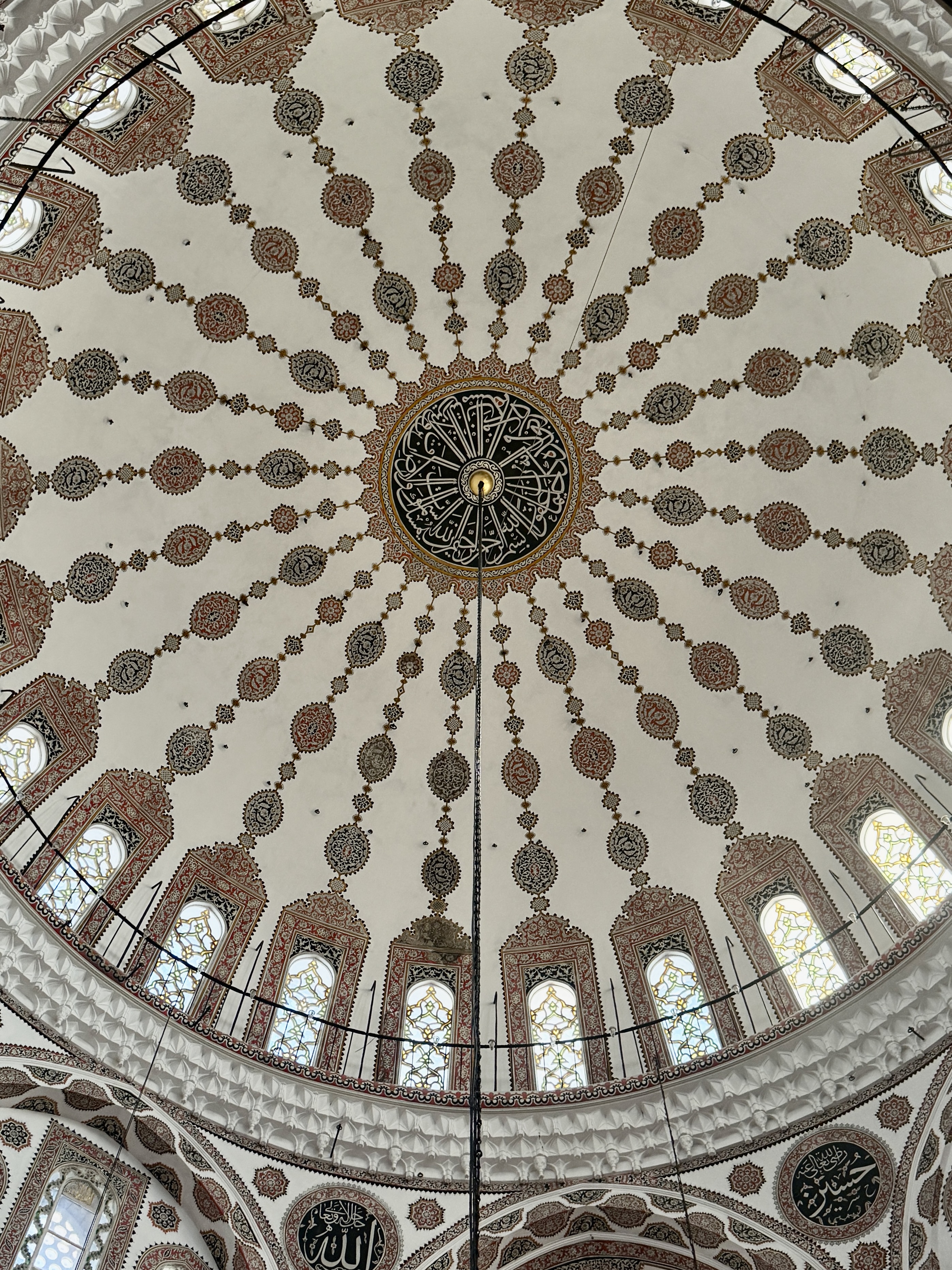
Geometry. Geometric pattern is the tradition's most recognisable signature. Built on principles of symmetry, proportion, and tessellation — shapes that interlock without gap or end — these designs speak of balance, order, and the unity of creation. Stars and polygons multiply outward, suggesting a pattern that could continue forever, a visual echo of the infinite.
Calligraphy. As the vessel for the words of the Qur'an, the written word holds the most honoured place in Islamic art. Over the centuries, distinct scripts emerged, each with its own temperament: the angular, monumental Kufic of the earliest Qur'ans and stone inscriptions; the round, legible Naskh used to copy books and manuscripts; the large, elegant Thuluth that sweeps across mosque walls; and the flowing Diwani perfected in the Ottoman court. In each, Arabic script becomes far more than writing — it becomes devotion given form.
Arabesque. Alongside geometry runs the arabesque: intertwining vines, leaves, and flowers that spiral across surfaces in endless, rhythmic growth. These motifs evoke the interconnectedness of the natural world and the beauty of creation. In manuscripts, this decorative tradition reaches its finest expression in illumination — the gilded borders and ornament known as tezhip — where pattern frames the sacred word in gold and colour.
A Brief Overview of Styles
Islamic art is not a single style but a family of them, shaped over centuries and across continents.
Its foundations were laid under the early Umayyad dynasty, when artists drew on Byzantine and Persian sources — adapting the mosaic, for instance, but emptying it of human figures. Under the Abbasids, a distinctly Islamic visual language matured, and the arabesque was refined into the flowing, vegetal form we recognise today.
From these roots grew the great regional traditions. Persian art became known for its jewel-like tilework, illuminated manuscripts, and delicate painting. The Ottomans raised soaring domes and slender minarets, and covered their interiors in luminous tile. Mughal art in the Indian subcontinent married Persian, Turkish, and Indian sensibilities into work of grand scale, symmetry, and ornament — the Taj Mahal among its crowning achievements. And in Andalusia and North Africa, Moorish craftsmen filled arches and courtyards with intricate stucco and pattern, as at the Alhambra.
Different in surface, these styles share a common instinct: to channel creativity into abstraction, ornament, and the crafted object, and to find in pattern a way of speaking about the divine.
In Closing
Islamic art is more than a visual tradition. It is a sustained expression of faith, culture, and craft — one that turns the ordinary into the extraordinary, uniting beauty, intention, and meaning so that even a functional object becomes an act of devotion.
Whether through the quiet symmetry of a geometric star, the resonance of a Qur'anic verse in flowing script, or the endless unfurling of an arabesque, it invites us to slow down and reflect on the eternal. That invitation is as alive today as it was a thousand years ago.
This is the first in a series exploring the world of Islamic art — from calligraphy and geometry to the spiritual dimension of pattern. Sign up to our newsletter to follow along and have each new journal entry sent to you directly.